Showing posts with label SOA. Show all posts

November 21, 2008

Information Technology in Mergers, Acquisitions (M&A) and Joint Ventures (JVs) - Part II

In the first part of this post, I had very briefly painted the big picture and also subtly emphasized on the need for a more agile and flexible IT (Information Technology) infrastructure for enterprises. In this article, we will wear the hat of an IT innovator and see some of the aspects of a manufacturing enterprise that an IT leader will need to consider in the process of choosing an SOA-based approach to manufacturing.

We should always understand one thing -
Change is the only thing that is Permanent. Change is the Rule of Nature

A wise leader is one who chooses to build an enterprise that is flexible to this permanent phenomenon called Change. With Change being permanent, the onus is now on the leader to make sure that this Change always happens for the good (a positive change) and with minimal incremental cost.

In the context of Information Technology, IT Leaders are often presented with such situations of having to make a choice between multiple solutions. This is when a leader needs to look through the telescope and see the solution from a long term perspective. An IT architecture that will scale up faster with minimal change with high utilization of existing investment and legacy systems is the basic need.

The manufacturing space is flooded with a lot of industry standards, and the IT infrastructure has to be able to support all of these industry standards. The standards defined by ISA, like the SP95 and SP88 models are the core of any manufacturing industry. It is very important that an IT infrastructure supports the ISA SP95/88 models at the least.

With the advancements made in the technology space, the IT infrastructure should be able to support the latest concepts of social networking, blogging, wikis, instant messaging, etc. Also, this new infrastructure has to be able to support newer hardware technologies like newer readers, sensors, mobile devices, embedded devices, etc.

Also, with the generation-Y people coming into the manufacturing workforce, it becomes an even more challenging task for the IT Leaders to create an IT infrastructure that will attract more of this new generation engineers to the manufacturing industry.

With so many factors to be considered, a flexible and agile IT infrastructure is the key. AMR Research precisely defines an SOA-based approach to manufacturing in its article titled Manufacturing 2.0: Defining Next-Generation Manufacturing. IBM has been a leading player in this space, with a structured approach to Manufacturing 2.0. IBM has partnered with several key players in this space to provide its customers with the Industry Frameworks approach. These frameworks helps the IT Leaders look beyond just MES or ERP systems...into creating an integrated manufacturing enterprise.

November 13, 2008

Information Technology in Mergers, Acquisitions (M&A) and Joint Ventures (JVs)

With the world economy undergoing a trough, most often people (in the business of IT) tell me -
Oh, we are going through tough times...while some of my customers are more resistant to new initiatives, some have declared really negative earnings for this quarter. I believe we need to wait and just let this period pass through...but again, the pressure build's up from my bosses!

This was actually told by a acquaintance of mine. I'm not surprised by this, as I've heard many others say this too. Echoing these words a few more times makes things more lucid than what it actually sounds like. As I've always believed in, every challenge comes with a set of opportunities.

Since the past few years, one would have noticed the change in way businesses across the world starting looking at the market. We've seen a number of mergers and acquisitions (M&A) and joint ventures (JVs) happening across the different businesses. The resulting IT complexity has always been a challenging task for CIOs and other IT leaders of these businesses. What better news can IT vendors get? There is a CIO who is crying "It's a mess - HELP ME OUT!"

This is the time when IT vendors need to wear the innovator's hat. These times are the ones that offer utmost opportunities to IT solution vendors. India is a garden of such opportunities especially in the manufacturing space. From automotive to petroleum to steel industries, all companies are eying India as a preferred destination for setting up shop. Unlike the past, international players are looking at setting up joint ventures with Indian companies that helps them enter a new market in many ways.

On the other hand, Indian biggies are acquiring companies in other parts of the world. This has resulted in the merging of companies due to acquisitions, which again has posed considerable challenge to the IT heads of these companies. M&As are more than just two corporate entities merging. It's about merging of cultures, merging of values, merging of corporate and IT governance models.

So, in a nutshell, to an IT leader, such market moves (M&As and JVs) mean more than just "IT" integration. In my next article I would be diving a little bit deeper into this topic to talk about SOA in the context of manufacturing. Till then, stay tuned!

September 30, 2008

Service Oriented Architecture (SOA) - God's Own Architecture

Intended Audience: Anyone and Everyone!

Service Oriented Architecture (SOA), has for long been used by different people in different ways. Some have used this three letter buzzword to sell their products (without actually understanding what it really meant!), while some (a handful) have passionately sold their products by truly implementing SOA. Though there has been a lot of information about SOA in the internet, its always been a tough task to explain this to a layperson (say, a doctor or a fashion designer!)

In this article, we'll try to step aside from the 'serious' and 'geekish' SOA discussion, and get into a lighter way of looking at this three letter buzzword. We all know how complex God's creations have been. From the universe (this is still a black box to mankind!) to the creation of humans, God's creation has always amused mankind. In the IT parlance, God is the supreme architect of all what we see around and inside of us. For the sake of dicussion, in this article, lets consider the Human Body (yes, our very own body!) as a product, and SOA as the architecture. Do you see some similarities? Read on...

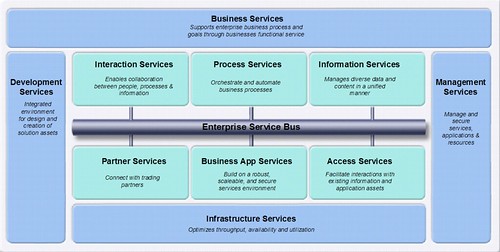
Before we jump any further, lets quickly recall the SOA Reference Architecture, as defined by IBM (an undisputed leader in this space!)

SOA

Above picture shows the SOA Reference Architecture defined by IBM. A closer look at it shows the different aspects of the SOA. The Enterprise Service Bus is the core integration backbone of the SOA. The rest of them are self-explanatory. Without delving much into this, lets quickly jump back into our mainstream discussion - God's Own Architecture.

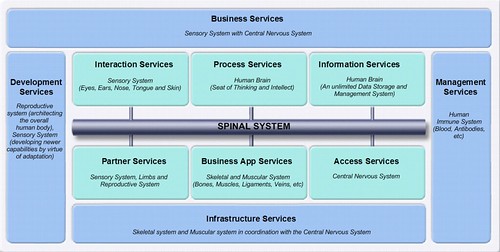
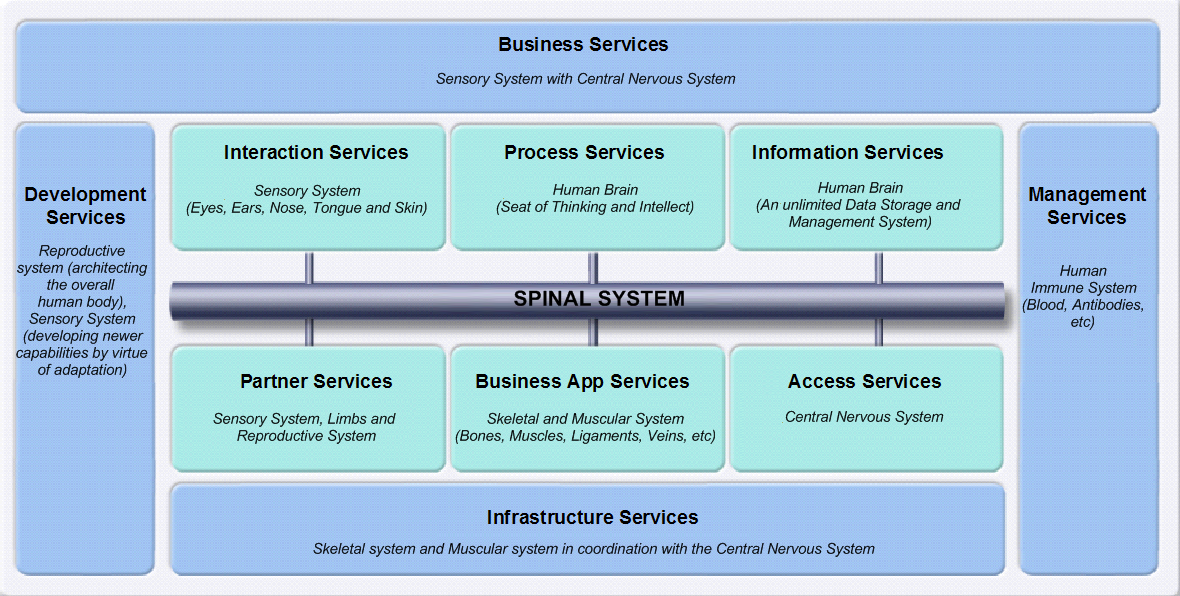
Lets extend SOA to the Human Body. As we all understand, the human body is one of the most complex, robust, flexible and agile systems. The below diagram is what I used to explain SOA to a doctor friend of mine.

SOA Human Body

A closer look at the above diagram will be good enough for you to understand the similarity. The Spinal System is the core of the human body (Its the integration layer!). The human brain takes care of the Process and Interaction Services. The human body is the most complex implementation based on SOA! This is very obvious with the fact that one cannot map a certain part of the body to only one aspect of SOA. For example, the human brain is so complex that one cannot rule out the participation of the human brain in Partner Services or Interaction Services.

In simple terms, apart from making laypeople understand SOA, the attempt here is to convey that Service Oriented Archtiecture (SOA) is God's Own Architecture (or, atleast close to it!). SOA has to be applied to the context of an industry to be able to understand its actual business value. In this article, we took the human body as an example. One might also want to consider the Solar System (with the Sun as the ESB, and so on) when explaining SOA to an astronomer.

So, Remember...SOA as a plain technology or business statement DOES NOT sell (and the world has seen this)! Industry content is the key!

September 10, 2008

CIOs and IT Leaders - Having SAP Nightmares? Read on...

I've seen a lot of buzz around SAP and heard a good number of my customers/partners raise this concern in the past many months. I've also been following the series of articles by Thomas Wailgum at CIO.com on this topic. In this article, we'll try to take a few steps back in time, and understand how it started. We'll also see how it evolved over time. Towards the end, we'll also see, as leaders in the IT space, a way to tackle this. The its and this' refer to the ERP bugaboo.

It all started in the early 2000's, right after the dot com boom, when the senior IT management teams of many companies wanted to manage their wide spread businesses effectively. From a management perspective, they thought that having a single ubiquitous platform would help from both talent acquisition and software management perspectives. This was the time when SAP's ERP suite was launched (mySAP ERP was launched in 2003). This suite offered four individual solutions, each addressing specific functional areas, namely-
  1. Human Capital Management
  2. Financials
  3. Operations
  4. Corporate Services
Over the next few years, these customers of SAP were happy with their investment decisions. These companies started to implement these solutions for their enterprises. But slowly, over a period in time, these companies pretty much reached a stage where they completed implementations of these solutions. As their corporate footprint and needs increased, they sought SAP's assistance to deploy these solutions for the newly inducted companies as well.

In the background, there was this monster called complexity that was growing. SAP was continuously adding newer features and releasing newer versions of these solutions. With the new deployments of SAP's solutions, these customers slowly started to realize that they needed to manage these different versions of solutions across their enterprises. This is when SAP introduced their Netweaver integrated technology platform, which was intended to help manage this complexity of different SAP versions. However, they later chose to call this a service-oriented application and integration platform.

Assuming the above fixed the problem of complexity, these companies started to look at the other side of the business - beating the competition and creating a unique business value to their customers. This resulted in the business teams of these companies coming up with some strategic initiatives and strategic business processes. This is when the ball was thrown back to the IT Leaders and CIOs to think of ways to implement these strategic business processes.

Still enchanted by SAP's ERP solutions, these IT Leaders resorted to implementing these strategic business processes in the same SAP platform using the programming languages like ABAP, etc. Now, the monster started to surface again! This time, it came with a greater force and impact. With the existing complexity of managing different versions of the SAP ERP, the companies were now put through a challenge of having to deal with different versions and fixes of these individual custom processes/modules that were deployed to address their strategic initiatives.

Let us now try and remind ourselves that SAP ERP was designed to address the resource management related processes (related to corporate operations, financial processes, human capital managment and the like). These processes are typically found in every enterprise, whatever industry or business they may be. When we talk about strategic business processes, we refer to those unique business processes that help an enterprise/corporate differentiate itself from its competition. The truth is that SAP's ERP was NOT designed to handle this! So, it was a Square Peg in a Round Hole.

IT Leaders looked at managing complexity in the short term, but failed to see the complexity in the longer run. So, is there a way to tame this man-made monster called complexity? Yes, there is. Read on...

Start differentiating between your strategic business processes and your ERP processes. Keep the latter in your existing ERP and move the former to a common, enterprise-wide platform that conforms to IT and Industry Standards. It's very important to think about the IT and Industry standards because your enterprise is bound to have disparate lines of businesses and different softwares from different vendors. You will need to have a platform that will seamlessly integrate these different systems and software.

From an IT Standards perspective, Service Oriented Architecture (SOA) has is a proven approach that offers the maximum flexibility and seamless integration capabilities. Though SAP-AG chose to call their Netweaver platform as a service-oriented application and integration platform, it isn't really so. Just because your integration platform allows its applications to be exposed as Web-Services, does not mean that it is SOA compliant! To know more on the difference between SOA and Web-Services, read this article.

To summarize, take a closer look at your ERP usage and try to separate out those non-ERP business processes. Adopt the SOA approach to your enterprise's IT architecture. It helps your business and IT be more flexible, agile and robust.

For further reading:
  1. AMR Research article titled SOA will kill ERP
  2. Forrester Research on ERP and SOA

August 27, 2008

Chemical & Petroleum Integrated Information Framework

One of the key challenges that the Chemical & Petroleum industry faces today is the inability to make timely business decisions in areas related to performance and field operations in both upstream and downstream parts of the business. The reasons for this challenge are plenty (functional and technical). From a functional perspective, some of them are -
  1. Operational managers and production supervisors do not have access to visibility to the plant's assets
  2. Failure reports get delivered too late, and are often signaled by an alarm (with sound and light)
  3. Failure reports are not intelligible enough to understand the problem to decide on a course of action
  4. All assets and entities in the plant adhere to their own standards of operation; this results in too many standards in one place; manageability becomes a key concern
Technically, the reasons can be attributed to -
  1. A multitude of data sources
  2. Too many instances of data get created from the different data sources
  3. There are many systems that are involved in the managing of these data instances
  4. Each data source follows its own standard in creating data; managing disparate data instances with unique standards becomes a challenge by itself
We at IBM, have been observing this for quiet sometime now, and we do have an answer now! Yes, IBM has come up with yet another innovative and business-driven solution called the Chemical & Petroleum Integrated Information Framework; in short, its called C&P IIF.
Chemical and Petroleum Integrated Information Framework (C&P IIF) is the software framework for real-time comprehensive integrated information across multiple disparate systems based on industry standards and an SOA approach. It enables real-time visibility and process collaboration with alerts and event management to speed problem determination plus optimization of existing resources:
  • For upstream oil and gas, C&P IIF framework enables implementing integrated operations that can decrease production costs while increasing oil field recovery percentages
  • For plants, C&P IIF enables real-time operations feedback driving integrations that can decrease production costs and improve refinery safety
  • For drilling, C&P IIF provides a comprehensive view across heterogeneous drilling formats for corporate analysis and easier handoff to production
For more information, do visit the IBM Chemical & Petroleum Integrated Information Framework web page here. A PDF version of the brochure is available here. You can also write to me to know more on IIF.

Sources: IBM

February 21, 2008

Recycling Rewards - Its an IBM built Rails App!

Seth Chisamore from IBM in Atlanta Kiosk Group built a really unique Kiosk application for RecycleBank that lets students at Columbia University recycle at a kiosk, gain points for their contribution and get rewards from places like Chipotle. This takes the RecycleBank Business Model to the next level - Earn rewards by recycling!

RecycleBank Kiosk

Direct report from Columbia TV News...

A new recycling program created by Columbia Business School alum has just been introduced to first-year students. Students earn rewards for going Green, getting points that can be exchanged at local restaurants.

RecycleBank gives Columbia students an economic incentive to be more environmentally friendly with a simple process - “recycle, record, reward.” The program is part of the University’s Go Green Initiative, and it began for first-years in Carman, Furnald, John Jay, and Wallach on Monday. If it’s successful, it will expand to the rest of the campus in the fall.

Nilda Mesa, Columbia's Assistant Vice President of Environmental Stewardship, said, "Wherever RecycleBank’s gone in other cities, their recycling rates have increased dramatically. And that’s the kind of thing we’re looking for here.

We want to see our recycling rates just go through the roof."

Students received a bag for collecting recyclables and a key fob with their account barcode. They weigh their bag at one of the kiosks, scan their barcode, place the items in the proper receptacles, and can immediately see their earnings online.

RecycleBank Process

Barani Guttsma, RecycleBank's Director of Account Management, said, "If you put a bowling ball in, A. you’re going to feel pretty bad about it, B. you’re just going to reach your monthly cap that much faster. And I think after a while, you’ll see that it’s really not worthwhile."

A maximum of 50 points earned per month are mailed to students in the form of gift certificates for local stores, like Chipotle, Amir’s, and Pinkberry.

Mike Wymbs, SEAS 2011, said, "I like getting gift certificates to Chipotle. I’m going to actually do this instead of taking the easy way out and throwing plastic bottles in the trash."

Organizers hope other students will have a similar reaction.

A video report can be found at CTV News Online. You can also read about this in Seth's blog post.

Great work, Seth!

February 06, 2008

Busting the myth about SOA and Web Services

As I've mentioned in many of my earlier posts, people have increasingly confused the terms SOA and Web Services. Though companies and people are getting aware of the Service Oriented Architecture paradigm, some misconceptions still exist. I was recently on a telephonic conversation with an executive of a company, to explore options of working jointly in some areas of business and IT. I was totally surprised when I heard him say -
Our solutions are all based on Web Services. They are all SOA-ready

I asked him if he was aware of the differences between a solution that is based on Web Services and a solution that is built based on the SOA reference architecture. I was surprised to hear his reply -
Yes, our solutions are based on Web Services, which is why I said that they are SOA-ready

Getting back to the present moment, let me take a minute to define what Service Oriented Architecture really means in simple terms -
SOA is a flexible architecture of business capabilities being supported by loosly coupled IT elements

Web Services simply means "a software system designed to support interoperable Machine to Machine interaction over a network"

To summarize, Web Services are the building blocks of SOA; Web Services is not SOA!

For a better understanding on the fundamentals, please visit this link.

November 19, 2007

Two most (Ab)Used words of 2007

The year 2007 has seen a lot of changes from an economic standpoint for various countries in various ways. The United States has seen a fall in the USD value while the Euro has shown a steady growth. India and China have been showing tremendous progress in the Asia Pacific.

With the economic boom, most of the countries have been wanting to ride on the wave to possibly create newer markets. This has resulted in the usage and creation of a lot of buzzwords. Some created them, while the rest have used (and abused) them.

"Innovation" has been topping the list so far. This word was mostly used by the CxO commuity (especially CEOs) in an attempt to redefine/ realign various areas of business (viz., strategy, finance, infrastructure, etc). With obvious reasons, there got created a lot of areas in the Line of Businesses where roles were created to focus on Innovation. Remember, this is the case with the biggies like IBM, Microsoft, Airtel, and the like.

This has though seen a lot of other players use the "Innovation" buzzword to attract customers and market mind share. For example, there are companies in the IT services sectors, which have started to use the "Innovation" buzzword in their services offerings. But if one really takes a closer look into the history of their operations and approach to even a year back, they would find nothing significantly different except the use of the "Innovation" buzzword. I'm not trying to generalize this to all companies! Its just a set of them.

The second (ab)used word is the acronym "SOA". This word "SOA" stands for Service Oriented Architecture. This is a very key architectural approach, but has been construed by many people in the sales area as a "single entity or a sellable product". The technical community have focussed on the "SOA" buzzword so much, that they have started to forget the underlying programming languages and constructs that help create an SOA.

There was a person whom I "almost interviewed" the other day, as he claimed to have worked on SOA. This apprised me to the fact that the IT junkies whose resumes one time read "J2EE Expert", today reads "SOA Expert"! This is the height of (ab)use.

With the growth in market and oceans of opportunities being created, I'm sure we will witness many more such buzzwords being created. Its imperative to nail down this kind of usage and help the world clearly understand what these buzzwords really mean.

September 24, 2007

Orchestr8 AlchemyPoint - Mashup unleashed..

Woah! I'm just out of a new product website, and the experience is fantastic! I stumbled upon Mashmaker from Intel a few days back...but here is something I just bumped into - Orchestr8 AlchemyPoint - A full-fledged enterprise-level mashup platform. Here is what the founder Elliot Turner has to say about his new product -

"Orchestr8 is the only mashup/integration infrastructure company offering a complete application server, distributed messaging framework, and web services protocol stack integrated into its product line. Many man-years of engineering effort have been dedicated to building Orchestr8's protocol stack capabilities, ensuring the system's interoperability with high-end Enterprise SOA/application-integration offerings from companies such as Microsoft, Oracle, and SAP"

Highlights of the Orchestr8 AlchemyPoint platform include:

  • Unified System that Combines the Best of SOA and Mashups
    The AlchemyPoint platform provides a unique combination of mashup and SOA technology, with its integrated application server, data scraping/transformation capability, and web services stack.
  • Unmatched Structured Content Scraping/Transform Capability
    Orchestr8 has developed a variety of innovative structured content scraping and data transformation capabilities that offer significant improvements in both reliability and performance over traditional systems. These capabilities include the ability to extract and manipulate information from non-Web data sources such as text files, database fields, etc.
  • Transparently Mashes Up Existing Web Sites / Applications
    The AlchemyPoint platform enables the transparent integration of new functionality into existing web sites and Intranet portals. This transparent integration approach allows for organizations to more fully leverage the value of existing IT investments.
  • Free Desktop Version and Open Source Developer Community
    Orchestr8 offers a freely-available version of its AlchemyPoint Desktop Edition software to end-users and the open-source developer community, to foster innovation within the mashup user/developer community.
I've just signed-up for a technology preview of this interesting product. Just hoping to get an unlimited access (with the amount of time I have..) Do await my reviews in the days to come...

_________________________________________________________________
Pssst...Im just updating this posting here....I got my tech-preview access enabled! Let me try this out...

July 19, 2007

SOA Facts - One of the most hilarious websites!

This has been one of the most hilarious websites I've seen so far. For those who are still looking at the roof and scratching your head, wondering what this three letter thing is - SOA refers to Service Oriented Architecture.

"SOA is an IT architectural style that supports service orientation" - thats how the official definition of SOA goes. For those people who have just entered the IT industry, its something that is in the lines of the well known OOP (Object Oriented Programming) concept.

In my opinion, SOA has been one of the most abused words in the "IT English jargon". Here is what I mean...
  • Job sites read "SOA Architect wanted!", but they recruit a person who has done work on EAI and has read SOA for Dummies
  • Customer requirements read "SOA based architecture for middleware", but end up creating yet another J2EE MVC (Model-View-Controller) architecture with some web-services
  • Business deals conclude as "SOA Win!", when a set of Application Server licenses are sold
Here is a website that I got to bump into, which has listed some hilarious one-liners about SOA. Its called "SOA Facts" and the link is "www.soafacts.com". Hats-off to the authors who have taken time to list these down. Here are a couple of sample one-liners from www.soafacts.com
"Software architects don't use SOA. SOA uses software architects
--------------------------------------------
"Implementing SOA for the first time is the triumph of imagination over intelligence.


A good read during breaks. Share it with your SOA comrades.